

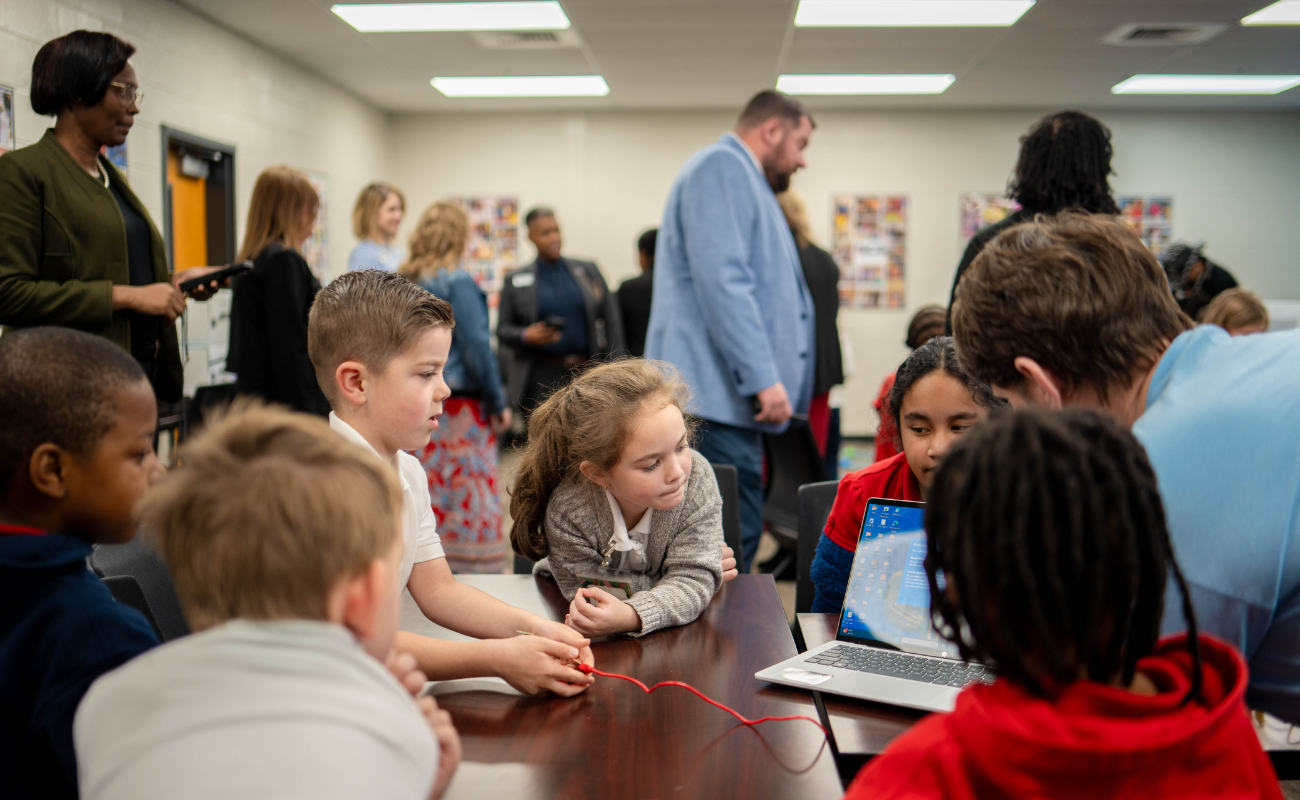

The most meaningful climate progress often happens quietly. More and more, businesses are recognising that the workforce who will deliver net zero is still in school today and that's where lasting impact begins.
Because here's the uncomfortable maths. Across the UK, US and Ireland, the same gap is widening: demand for green skills is outpacing supply roughly two to one, and the demographic pipeline behind it is shrinking, not growing.
-
In the UK the demand for green skills grew 46% last year while supply grew just 5.3%. The country needs 400,000 new green jobs by 2030.
-
In the US the hiring rate for green talent is 80.3% higher than the overall workforce. The American Welding Society projects a shortage of 320,000 welders by 2029, and 30% of union electricians are expected to retire within a decade. The IEA reports 2.4 energy workers in advanced economies are nearing retirement for every new entrant under 25.
-
In Ireland 12.4% of all job openings now require at least one green skill which is the second-highest share globally after the UK. The Build Up Skills Ireland 2030 report projects a shortfall of up to 120,000 workers in the built environment alone to deliver climate and infrastructure goals by 2030. 76% of Irish employers see skills gaps as a barrier to organisational transformation, 13 points above the global average.
That gap won't be closed by adults retraining alone. It will be closed by the ten and eleven year olds sitting in classrooms around the world today.
Why climate-skills education is the highest-leverage move you can make
Of all the things a company can fund, the evidence base around early STEM and sustainability education is the strongest and the most directly tied to the climate transition.
A 2025 Nature meta-analysis of robotics-based learning found large effects on academic achievement and computational knowledge versus traditional teaching. A seven-year study published in Sensors showed that early robotics and coding interventions in urban primary schools produced measurable, lasting gains in design knowledge, coding skill and aspirations toward computing careers.
The career-shaping evidence is just as strong. UK research from Education and Employers, now embedded in the Gatsby Benchmarks, found young people with four or more meaningful employer encounters during school are significantly less likely to end up NEET and earn wage premiums of up to 18% as adults. Each additional employer contact is worth around £900 in extra annual salary. US research echoes the pattern: only one in three teenagers say they have the skills needed for green-economy jobs, and nearly 30% say they don't even know where to find one.
And the window is narrower than most companies realise. Education and Employers' "Drawing the Future" study of 20,000 children found career aspirations are largely set by age seven, are heavily gender-stereotyped, and "have nothing in common" with projected labour-market demand. In Ireland, I WISH research found a third of teenage girls are still discouraged from STEM careers by stereotype, and only 68% of all-girls schools offer STEM subjects beyond mathematics and science, against 96% of all-boys schools.
This means that if a child has never met an engineer, a renewable-energy technician, a climate scientist or a sustainable designer by primary school, the probability they'll become one drops sharply.
What the core skills of climate action actually are
The capabilities the climate economy demands from the next generation cluster into four key areas:
Technical and engineering literacy. Designing, building and maintaining the physical infrastructure of net zero such as heat pumps, wind turbines, EV systems, retrofit, grid technology.
Computational and data skills. Climate modelling, carbon accounting, AI-enabled optimisation, smart-grid management. LinkedIn's 2025 data names energy management as the fastest-growing green-skill category worldwide. Coding and robotics in primary and secondary education are the entry point with the evidence showing even short, well-designed interventions move both skill and career interest.
Systems thinking and sustainable design. The ability to see a product, building or service as a flow of materials, energy and consequences. Ireland's Green Skills 2030 strategy explicitly calls out circular-economy thinking, carbon literacy and biodiversity as cross-sectoral skills the workforce currently lacks. Best taught through hands-on challenges where children design something, for example a school, a city, a delivery system, and then where they learn to weigh trade-offs.
Problem-solving under uncertainty. The climate workforce won't follow a fixed playbook. The PISA framework now formally measures collaborative problem-solving for this reason. Project-based learning, robotics competitions and design challenges build the muscle.
Programmes that teach one of these in isolation are useful. Programmes that integrate all four, through curriculum-aligned, hands-on, multi-visit engagement, are what move outcomes.
What good looks like in practice
Across the UK, US and Ireland, there are working models. They share three features: they operate at scale, they target named workforce gaps, and they produce measurable outputs that map directly onto regulated reporting frameworks.
JLR's Create Possible (UK) delivers curriculum-aligned STEM resources for 11–14-year-olds, supported by more than 1,000 STEM and Campus Ambassadors who reached over 130,000 students in 2024–25. 9,000 young people completed Virtual Work Experience in two years. The JLR Foundation has committed £2.5m to disadvantaged-young-people programmes, designed explicitly against JLR's own diagnosis of who isn't currently seeing themselves in engineering.
Amazon Think Big delivers hands-on STEM learning through more than 100 Think Big Spaces, Corners and Mobile Vans worldwide, helping young people explore technology, engineering and innovation through robotics, coding, AI and sustainability-themed challenges. Having engaged more than 100,000 students globally, the programme develops future-ready skills while improving access to STEM education in underserved communities.
Silverstone Family Zone brings STEM learning to one of the world's most iconic sporting events, engaging around 5,000 visitors per day during the Formula 1 British Grand Prix. Through hands-on engineering, coding, robotics and design challenges, families explore the technology and innovation behind motorsport while developing problem-solving, creativity and teamwork skills that underpin many future green and engineering careers.
BAE Systems has invested over £1bn in education and skills, recruiting more than 10,000 apprentices and graduates since 2020. 30% of new apprentice intakes are female versus a 17% industry average. Its schools roadshow reaches 420 schools and 90,000 students a year.
Schneider Electric & Tottenham Hotspur Foundation launched a sustainability-focused STEM programme designed to inspire the next generation of engineers and innovators. Working with disadvantaged schools across North London, the initiative engaged more than 120 students, 12 schools and 40+ Schneider Electric volunteers through hands-on robotics, coding and engineering challenges linked to green energy, sustainability and future careers. The programme demonstrates how businesses can connect ESG ambitions with meaningful, measurable community impact.
A practical framework for sustainability leaders
If you're rewriting your CSR plan for 2026, six principles separate programmes that build legacy:
-
Start with the gap. Identify the specific workforce, demographic or community gap your business has visibility on. JLR built around its "STEM is just for boys" finding. BAE built around the engineering apprenticeship shortfall. SSE Airtricity built around Ireland's 120,000-worker built-environment gap. Generic "STEM outreach" without a named target rarely produces named outcomes.
-
Reach children early and often. The "four meaningful encounters" threshold is real. Below it, you're producing impressions. At or above it, you're producing employment outcomes. Build programmes that come back to the same schools, the same children, year after year
-
Make it hands-on, not theoretical. Robotics kits, coding challenges, sustainable design projects, work alongside engineers on real problems. The evidence base is overwhelmingly stronger for active learning than passive exposure.
-
Target underserved schools deliberately. JLR's 2025 survey found London pupils were nearly twice as likely as the UK average to attend extracurricular STEM activities. US clean-energy workforce data shows the same pattern by race and zip code. Irish I WISH research shows the same by gender and school type. If your programme just reaches the schools that already have STEM provision, you're not closing the gap.
-
Equip teachers, not just students. A workshop ends in a day. A trained teacher with curriculum-aligned resources runs the same lesson for 30 years. The multiplier on teacher-focused investment is the highest in education-led CSR.
Measure outcomes, not outputs.
Counting how many children attended a workshop gives an indication of your reach however deeper measurement gives your insight into whether your programme is having the desired effect.
Outcome metrics include:
-
Skills acquired. Pre- and post-programme assessments of carbon literacy, coding competency, sustainable design thinking or systems reasoning. A child who couldn't explain the circular economy in September and can in June is a unit of change.
-
Aspirations shifted. Surveyed change in whether young people see themselves in a green or STEM career, and which children specifically. Movement among girls, low-income pupils or underrepresented ethnic groups matters more than aggregate uplift.
-
Teachers equipped. Number of educators trained, lessons delivered after the company has left the building, and the multiplier effect over a 3–5 year horizon.
-
Equity of reach. What share of the children you reached attend schools in the lowest funded locations. Reach without equity widens gaps rather than closing them.
The companies leading on climate in 2030 will be the ones who started investing in the eight-year-olds of 2026. Not because it makes a nice annual report photograph, but because the maths of the green transition doesn't work without them.
400,000 jobs in the UK. 32 million energy hires in the US between 2025 and 2035. 120,000 missing built-environment workers in Ireland. These numbers don't get smaller while we wait.
The future of corporate responsibility isn't about defining your purpose. It's about whether you've built the people who can deliver it.
Build a curriculum-aligned, hands-on STEM and sustainability programme that closes named workforce gaps, equips teachers for the long haul, and produce the outcomes your business needs in the future, all in partnership with Creative Hut.
Want to learn more? Explore our STEM, sustainability and CSR programmes and discover how your organisation can create meaningful, measurable impact. Click here to get started.




Share:
How Education-Led CSR Strategies Drive Meaningful Social Impact
Building Confidence in the Classroom: Empowering Teachers with LEGO Education